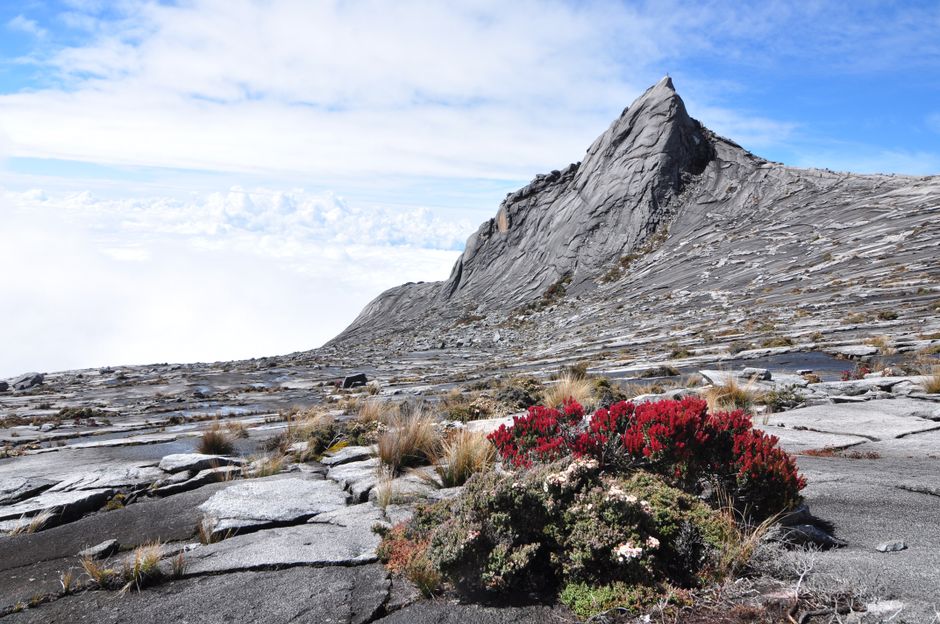
Most people hear “Kinabalu” and immediately think about climbing to the summit. Fair enough. Mount Kinabalu is the main attraction, and at 4,095 metres, it dominates almost every postcard of Sabah.
But you don’t need to spend two days climbing the mountain to enjoy this place.
Around the Kinabalu Park headquarters, there’s a network of shorter forest trails that you can complete in anything from 20 minutes to several hours. Some follow cold mountain streams, while others climb through mossy forest to quiet viewpoints. They’re far less demanding than the summit route, and you normally don’t need a mountain guide to walk the regular nature trails.
Officially, the protected area is called Kinabalu Park, although many travelers search for it as Kinabalu National Park. The park covers more than 75,000 hectares and protects habitats ranging from tropical rainforest to sub-alpine vegetation near the mountain’s granite summit. It became Malaysia’s first UNESCO World Heritage Site in 2000.
Here’s what you should know before exploring the best hiking trails in the Kinabalu National Park.
Kinabalu Park Trails and the Mount Kinabalu Climb Are Different
This confuses quite a few first-time visitors.
The hiking trails around Park Headquarters are ordinary day trails. You enter the park, choose your route and walk through the forest before returning to your accommodation or continuing to Kundasang.
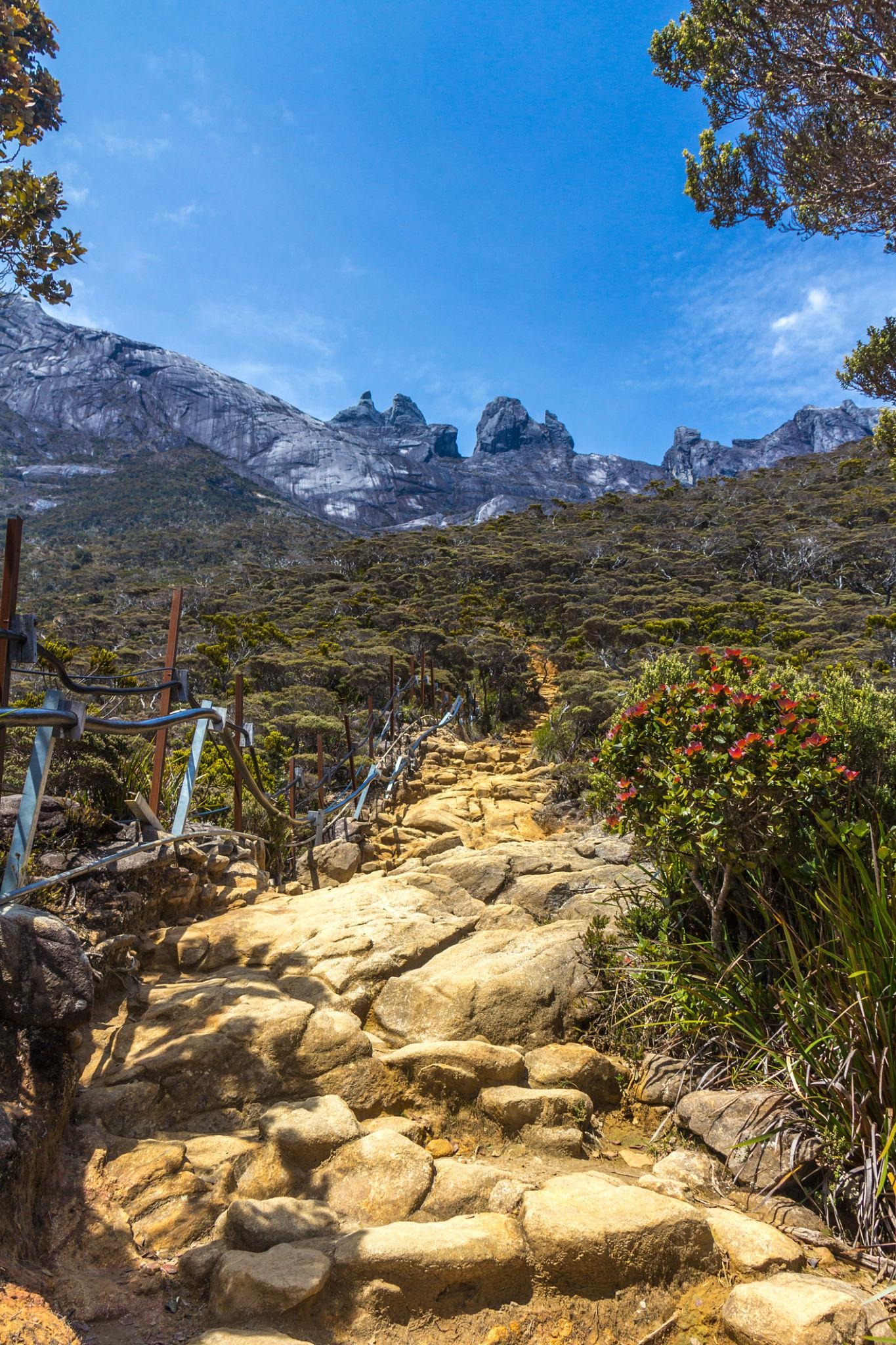
Climbing Mount Kinabalu is a completely separate activity. Summit climbers must have a climbing permit, confirmed accommodation and a registered local mountain guide. The normal journey involves hiking approximately six kilometres from Timpohon Gate to Panalaban on the first day, followed by the summit attempt and descent on the second day.
Honestly, don’t think of the shorter trails as a disappointing replacement for the summit. They offer a different experience. You’re walking slowly enough to notice the moss, orchids, fungi, tree roots and small forest streams that summit climbers often rush past.
How to Get to Kinabalu Park
Kinabalu Park Headquarters is roughly 92 kilometres from Kota Kinabalu and sits at about 1,520 metres above sea level. The drive usually takes around two hours, although traffic leaving Kota Kinabalu and slower vehicles on the mountain road can make it longer.
Driving or Hiring a Private Car
A rental car is the easiest option, especially when traveling with two or more people. It also gives you the freedom to stop at Pekan Nabalu, Kundasang or roadside viewpoints.
The road is paved, but it becomes winding as you climb into the highlands. Drive carefully in heavy rain and fog. Parking is available around the park area, though arriving early makes everything easier.
Shared Minivan or Bus
Minibuses and shared taxis heading toward Kundasang or Ranau leave from Kota Kinabalu. Tell the driver clearly that you want to stop at the Kinabalu Park entrance. Sabah Tourism also lists minibuses and taxis from the Jalan Padang area for destinations along the Kundasang–Ranau route.
Travelers commonly report fares of around RM30 each way, but treat that as a rough guide rather than a fixed price. Schedules, departure points and fares can change.
The annoying part is the return journey. Vehicles traveling back to Kota Kinabalu may not follow a reliable timetable, particularly later in the afternoon. Ask your accommodation or the park counter about transport before starting a long hike. Don’t wait until 5pm and assume a minivan will magically appear.
Joining a Day Tour
A tour costs more, but it removes the transport headache. This makes sense for solo travelers or anyone combining Kinabalu Park with Kundasang and nearby attractions.
Just check how much actual walking time is included. Some “Kinabalu Park tours” spend only a short time inside the park before moving on to photo stops, farms and souvenir markets.
Best Time to Hike in Kinabalu Park
You can visit throughout the year, but February to May is generally the drier period. October to January tends to receive more rain. Even during the supposedly dry months, mountain weather can change quickly, so a sunny morning doesn’t guarantee a dry afternoon.
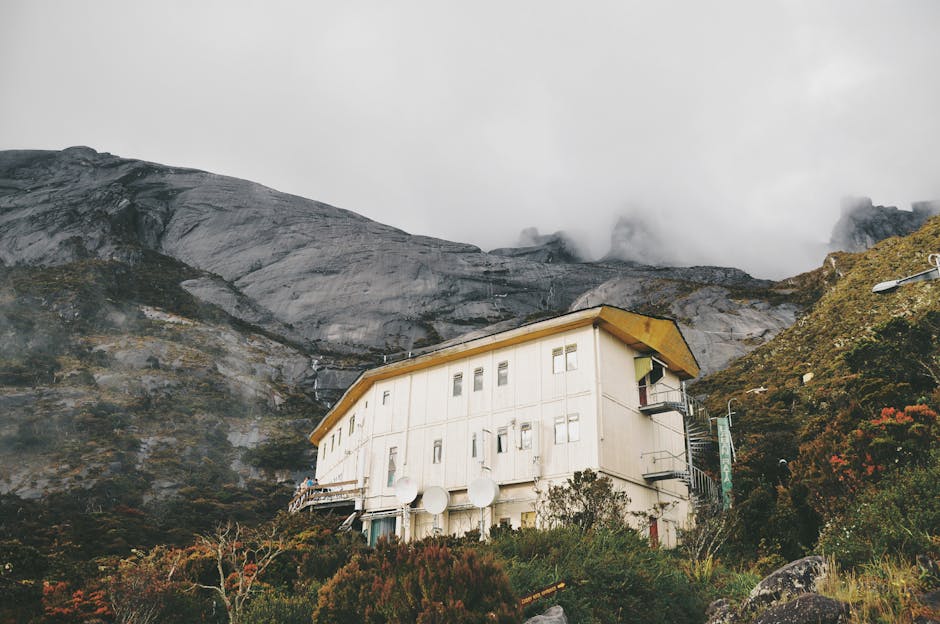
Temperatures around Kinabalu Park are usually much cooler than Kota Kinabalu. The park area commonly experiences temperatures between 15°C and 24°C, while the wider Sabah highlands average around 21°C.
Start hiking between 8am and 9am when possible. The forest feels fresh, the trails are quieter and you have a better chance of seeing Mount Kinabalu before clouds cover it.
The Best Hiking Trails in Kinabalu Park
Silau-Silau Trail: Best for Beginners
Approximate distance: 3 to 3.4 kilometres
Time needed: 1 to 1.5 hours
Difficulty: Easy
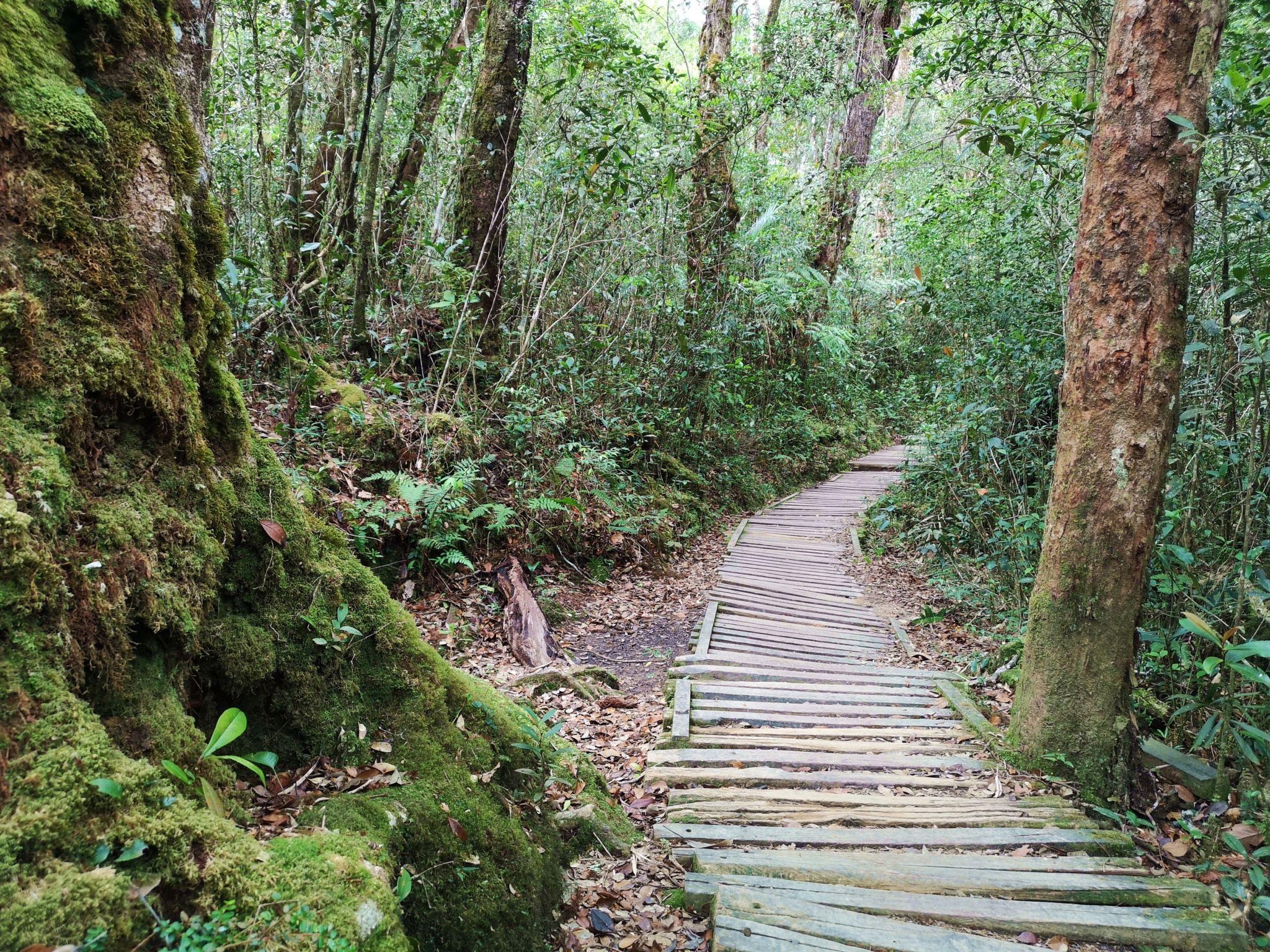
Silau-Silau is the trail I’d recommend to most first-time visitors. It follows a cool mountain stream through damp, mossy forest and connects with several other trails, so you can shorten or extend your walk depending on the weather.
The terrain is mostly gentle compared with the hill trails. Expect roots, wet leaves and a few slippery sections rather than long, exhausting climbs. The humid environment supports plenty of mosses, ferns and orchids, making this one of the park’s nicest trails for slow nature photography.
This is also a sensible option for families, older travelers and anyone who wants a proper forest walk without turning the day into an endurance test.
Liwagu Trail: Best for a Longer Forest Adventure
Approximate distance: 5.5 to 5.6 kilometres
Time needed: At least 3 hours
Difficulty: Moderate
Liwagu is the longest and most adventurous of the commonly walked trails around Park Headquarters. It follows parts of the Liwagu River through thicker forest, with more uneven terrain, streamside sections and changes in elevation.
Surprisingly, it can feel much more remote than you’d expect considering how close you are to the main park facilities.
Trail descriptions list Liwagu at approximately 5.5 to 5.6 kilometres. Some hikers take three to four hours, especially after rain or when stopping frequently for photographs.
Don’t start Liwagu late in the afternoon. Carry enough water, save an offline trail map and confirm which exit you’re aiming for before entering. Trail junctions aren’t always as obvious as urban park signs.
Kiau View Trail: Best for Views and a Moderate Workout
Approximate distance: 2.4 to 2.5 kilometres
Time needed: Around 1.5 hours
Difficulty: Easy to moderate
Kiau View follows an undulating ridge and offers views toward the surrounding valley when the weather is clear. It has more climbing than Silau-Silau, but it’s still manageable for reasonably active travelers.
What I like most about this route is the variety. You get forest walking, ridge sections and occasional openings in the vegetation rather than following one landscape for the entire hike. The main frustration is that clouds can hide the view completely, which is another reason to walk early.
Bukit Burung Trail: Best Short Climb
Approximate distance: 1.1 kilometres
Time needed: Around 1 hour
Difficulty: Moderate
Bukit Burung, meaning Bird Hill, is a good compromise when you want a bit of climbing but don’t have half a day.
The trail crosses the Silau-Silau area before climbing toward a shelter overlooking Park Headquarters, the lower Liwagu Valley and Mount Kinabalu when conditions are clear. You’ll pass cool stream valleys and drier ridge vegetation along the way.
It’s short, but don’t underestimate wet uphill sections. After rain, the descent deserves more attention than the climb.
Mempening Trail: Best for Creating a Longer Loop
Time needed: Around 1.5 to 2 hours by itself
Difficulty: Easy to moderate
Mempening is useful because it connects with several other routes, including Silau-Silau, Kiau View and sections near Liwagu. Instead of walking one trail out and back, you can combine them to create a more interesting loop.
A good combination for active visitors is Silau-Silau, part of Mempening and a lower section of Liwagu. Ask for the latest trail map at the entrance because distances shown by different maps and hiking sources sometimes vary.
Bundu Tuhan View Trail: Best When You’re Short on Time
Approximate distance: 465 metres
Time needed: Around 30 minutes
Difficulty: Easy
This short trail leads toward a viewpoint overlooking the Bundu Tuhan area. It’s ideal when you arrive late, have young children or simply want a quick walk before continuing to Kundasang.
The route is close to the main facilities and provides a brief introduction to the mountain forest without requiring a full hiking schedule.
How Much Time Do You Need?
Half-Day Visit
Allow three to four hours.
Walk Silau-Silau or Kiau View, visit the Botanical Garden and have lunch near the park or in Kundasang.
Full-Day Visit
Allow six to eight hours.
Start with Liwagu or a Silau-Silau–Mempening loop, eat lunch and then visit the Botanical Garden or one of the shorter viewpoint trails.
Two-Day Stay
This is the better choice for people who genuinely enjoy hiking. Stay near Park Headquarters or in Kundasang, walk the longer trails on your first day and return for an early morning forest walk on the second.
One thing most tourists don’t realize is how rushed a day trip can feel. A large part of the day disappears on the drive from Kota Kinabalu and back.
Don’t Skip the Botanical Garden
The Botanical Garden is small compared with the surrounding forest, but it’s worth visiting because many interesting plants are easier to identify there.
Sabah Parks currently lists the main park opening hours as 8am to 5pm, with last entry to the Botanical Garden at 3pm. Guided garden tours are scheduled at 9am, noon and 3pm, while a guided nature-trail walk normally begins at 11am from the Kinabalu Multipurpose Hall. Schedules can change, so confirm them at the counter when you arrive.
What to Eat Around Kinabalu Park
Food inside and immediately around the park tends to be simple and relatively expensive compared with ordinary local restaurants. For better variety, continue toward Kundasang or stop at Pekan Nabalu.
Look for:
- Grilled corn and sweet potatoes from roadside stalls
- Warm noodle soup, fried rice or rice with local vegetables
- Fresh highland vegetables grown around Ranau and Kundasang
- Sabah tea or locally produced dairy snacks
- Traditional Sabahan dishes such as hinava, a fresh fish dish prepared with citrus juice
- Tuhau or bambangan served as a pickle or side dish
Ranau is particularly known for highland vegetables and locally produced tea. At Sabah’s traditional tamu markets, you may also find regional foods and agricultural products, though carrying cash is useful because smaller vendors may not accept electronic payments.
Honestly, after a damp three-hour forest walk, a basic bowl of hot noodles can feel better than an elaborate café meal.
Lesser-Known Tips and Hidden Corners
Arrive Before the Tour Groups
Most organized groups arrive later in the morning. Being at the entrance around opening time gives you quieter trails and a better chance of clear mountain views.
Stop at Pekan Nabalu
Pekan Nabalu is a useful stop between Kota Kinabalu and Kinabalu Park. It has a market, toilets and a viewing area facing Mount Kinabalu. The mountain is usually easier to see in the morning or later in the day when cloud cover is lighter.
Look Down, Not Only Up
Everyone keeps staring at the mountain, but some of the most interesting details are at ground level: tiny fungi, moss-covered roots, insects and fallen petals.
Ask About Trail Conditions
A trail that’s easy in dry weather can become slow and slippery after several hours of rain. Check with park staff before choosing Liwagu or combining several routes.
Realistic Budget for a Day Trip
Current adult conservation fees are:
- Malaysian visitor: RM10
- International visitor: RM50
- Malaysian visitor aged 60 and above: Free of charge under the currently published fee structure
- Botanical Garden: RM4 for Malaysian adults and RM5 for international adults
Sabah Parks lists the park as open daily from 8am to 5pm. Fees and opening arrangements may be revised, so check the official information shortly before traveling.
For a simple self-arranged day trip, a sensible cash allowance is approximately:
- Malaysian traveler: RM100–RM150
- International traveler: RM140–RM190
That estimate covers shared transport from Kota Kinabalu, entrance fees, a basic meal, drinks and snacks. A private driver, rental car, organized tour or overnight stay will increase the cost.
The Mount Kinabalu summit climb is far more expensive because it involves separate permits, guide fees, transport, insurance and mountain accommodation.
What to Pack
You don’t need serious climbing equipment for the park’s ordinary nature trails, but a few items make the day much more comfortable:
- Shoes with reliable grip
- Lightweight rain jacket or poncho
- Small umbrella for walking around the park facilities
- Light fleece or jacket
- One litre of water for shorter walks and more for Liwagu
- Insect repellent
- Waterproof cover or plastic bag for your phone
- Small towel and spare socks
- Offline map or screenshot of the trail network
- Cash for transport, food and small vendors
Avoid heavy cotton clothing if rain is likely. Once it becomes wet, it stays cold and uncomfortable in the highland air.
Common Mistakes to Avoid
Starting a Long Trail Too Late
Mountain weather often becomes cloudier and wetter later in the day. Save the Botanical Garden and short viewpoints for the afternoon.
Wearing Smooth City Shoes
A trail can look easy on a map but still contain wet roots, mud and moss-covered steps.
Depending on Mobile Reception
Download maps and save your accommodation details before entering longer forest sections.
Packing Too Little Water
The cool temperature can hide how much you’re sweating. Drink regularly even when you don’t feel particularly hot.
Trying to Combine Too Much
Poring Hot Springs is about 40 kilometres from Park Headquarters, so it isn’t a quick stop next door. Also, the Poring Canopy Walkway has remained temporarily closed for major maintenance since July 2025. Check its status before building your entire itinerary around it.
Confusing a Park Visit With a Summit Climb
You can’t arrive casually in the morning and decide to climb Mount Kinabalu that afternoon. Summit access must be arranged properly, and a local mountain guide is compulsory.
Safety and Local Etiquette
Stay on marked trails and avoid collecting flowers, seeds or other plants. Kinabalu Park protects thousands of plant species, including many that are rare or restricted to the area.
Let someone know when you’re entering a longer trail, especially when traveling alone. Turn around if rain becomes heavy or visibility worsens.
There’s no special dress code for the regular nature trails, but wear practical, reasonably modest outdoor clothing. When stopping in nearby villages or markets, ask permission before photographing people, homes or private farms.
Most importantly, keep noise down. The forest is far more enjoyable when you can hear the streams, insects and birds instead of somebody playing music through a portable speaker.
Final Thoughts
Exploring the best hiking trails in the Kinabalu National Park isn’t only about reaching a dramatic summit.
For many ordinary travelers, the lower forest trails are actually the more accessible and relaxing way to experience the park. Silau-Silau is ideal for an easy first walk, Kiau View provides a moderate climb, and Liwagu gives stronger hikers a longer, wilder day in the forest.
Start early, expect rain, wear shoes with decent grip and don’t rush through the park just to tick off another attraction.
The mountain may be the reason you come here, but surprisingly, the quiet forest below it may be the part you remember most.


